
The Pakistan Cricket Board (PCB) has claimed to have earned three billion rupees by hosting the ICC Champions Trophy, exceeding its target of two billion rupees.

'It has also outlived its initial purpose of reducing physical gold imports.'

RBI's interest rate decision, quarterly earnings and global cues would be the major driving factors for equity markets this week, analysts said adding that the impact of the Union Budget could linger on this week. Trading activity of foreign investors will also be a key driver for the markets, experts noted. "US and India's manufacturing PMI for January to be released on Monday, will be the key macro data to watch out for.

In a continued push to spiritual tourism, there will be a focus on destinations related to the life and times of Lord Buddha.

Australia's state of Victoria has withdrawn as host of the 2026 Commonwealth Games, placing the future of the quadrennial multi-sport event in doubt
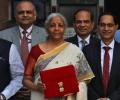
'The finance minister missed yet another opportunity to simplify the income tax structure in the Budget.' 'This was an opportune moment to get rid of the old tax system entirely and move fully to the new system,' asserts M Govinda Rao, member of the 14th Finance Commission.

Inputs from religious texts, scriptures of local dialects and inspirational word-of-mouth stories will also be included.

Do you have financial planning or income tax queries? Ask rediffGURU Anil Rego.

Defence stocks have been on a tear, with the Nifty India Defence index hitting all-time highs. Over the past week, the index jumped around 7 per cent, far outpacing the flat performance of the Nifty 50. Over the past month, its 12 per cent gain has trebled the benchmark's return.

The Budget should undertake further reductions in import tariffs and seriously consider an announcement of India's intention to join one or both of the two Asian mega-regional free trade agreements, suggests Shankar Acharya, former chief economic adviser to the Government of India.

The five largest exporters of major arms in 2020-2024 were the US (43 per cent), France (9.6 per cent), Russia (7.8 per cent), China (5.9 per cent), and Germany (5.6 per cent).

'Currently, it takes between two and three years to formulate the request for proposal for procuring specific military equipment for the armed forces. It should not be this way.'

"The new structure will substantially reduce taxes on the middle class and leave more money in their hands, boosting household consumption, savings and investment," Sitharaman said presenting what was dubbed as 'reformist' budget for the next fiscal in Lok Sabha.

'Spend, but create assets, spend but make sure that people benefit from it.' 'This has been a beautiful guiding principle. And I think as a finance minister I owe so much to the prime minister for keeping this path clear before us.'

If it was Andhra Pradesh last Budget, it's poll-bound Bihar that has now turned to Centre with a list of demands. How the NDA government is delivering on promises.
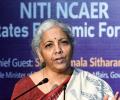
'Each state is unique, but when it comes to finance, the fundamentals cannot be different.'

'And this will persist given the two-and-a-half-front threat we face.'
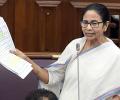
West Bengal Chief Minister Mamata Banerjee has slammed the Maha Kumbh as a "Mrityu Kumbh" (Death Kumbh), accusing the Uttar Pradesh government of suppressing the actual toll in the stampede that occurred at the religious gathering. Banerjee also criticized the lack of planning and management at the event, highlighting the plight of Bengal residents who died in the stampede. The BJP, however, has condemned Banerjee's remarks, calling her an "anti-Hindu chief minister" and accusing her of political opportunism.
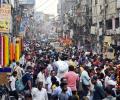
India will be the world's third-largest economy by 2028 as it becomes the world's most sought-after consumer market and gains share in global output, driven by macro stability influenced policy and better infrastructure, Morgan Stanley said. From a $3.5 trillion economy in 2023, the Indian economy is projected to expand to $4.7 trillion in 2026, which will make it the fourth largest in the world behind the US, China and Germany.
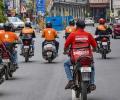
After a massive selloff in the shares of food delivery giants Zomato and Swiggy, analysts believe the time may be right for investors to start adding these stocks to their portfolio carts. Their optimism, they say, stems from the sharp correction in stock prices and valuations, which seem to have "over-baked" concerns about the two companies.
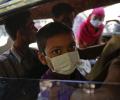
The mortality-to-incidence ratio for India was 64.47 per cent in 2022, the highest while comparing the top 10 countries with the highest number of cancer incidences.
'Nearly 10 million people will benefit from the increase in the rebate limit for those earning up to Rs 12 lakh.' 'We expect all that money will come back into the economy in either savings, consumption, or investments.'

'If delimitation is not handled well by the Centre, the southern states are certainly going to challenge it.'

Gold Coast mayor Tom Tate said on Thursday the city could step in to host the 2026 Commonwealth Games after Victoria placed the future of the quadrennial multi-sport event in doubt.

The risk-reward for the Indian markets, Morgan Stanley said, is turning favourable.

As temperatures shoot up this month signalling an early onset of summer, sales of air conditioners (AC) are set to increase, with companies expected to hike the prices of ACs by 4-5 per cent due to component shortages. Leading players like Haier and Bluestar and suppliers like EPack Durables have raised their production capacities to meet the 25-30 per cent rise in demand expected in the coming months.
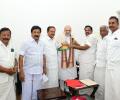
EPS has had its way on most things, alliance-wise. A week earlier, he reiterated that he would not re-admit OPS and Sasikala Natarajan back in the party. It was a message not just to detractors in the AIADMK. It was even more so for the BJP leadership in Delhi. Even more important for the AIADMK was their demand for accepting EPS as the chief ministerial candidate of any alliance that the party would form, observes N Sathiya Moorthy.

From FY20 to FY24, the revenue forgone due to tax incentives for individuals and Hindu undivided families stood at Rs 8.7 trillion, significantly higher than the Rs 4.53 trillion forgone for corporations.

Australia's state of Victoria will not host the 2026 Commonwealth Games due to projected cost overruns.

Many states are realising that hosting mega events puts the spotlight on them and raises their profile.

Why has the shift from ICE to electric slowed down despite initial enthusiasm?

'The bull market cycle ran for five years. It's the end of that cycle.' 'The next cycle is a down cycle, and in that down cycle, you will see the Sensex falling from their highs of around 68,000 to maybe 40,000-50,000 at the bottom of the cycle.'

'I believe that the overall demand for commercial vehicles will improve, even though there is a slowdown in the GDP.'

The finance minister's assertion that industry should not expect any spectacular announcements in the 2024 interim Budget suggest that the electoral imperatives of more tax concessions or higher expenditure on welfarist programmes could be far less pronounced than they were before the 2019 interim Budget, expects A K Bhattacharya.

Implications for capital gains, wealth taxes, and investment strategies require careful consideration, notes Anil Rego, founder and CEO, RightHorizons.
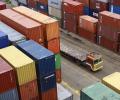
The US Trade Representative noted that India's average applied tariff rate stood at 17% per cent, the highest of any major world economy.

In a body blow to India's medal prospects in the Commonwealth Games, key sports such as hockey, badminton, wrestling, cricket and shooting have been dropped from the 2026 edition by host city Glasgow, which unveiled a pruned roster of 10 disciplines to keep the event budget-friendly.

Ask rediffGURU and PF expert Nitin Narkhede your mutual fund and personal finance-related questions.

Gopichand, who is often credited with creating a pipeline of top badminton players by identifying them at a young age, described the move by the games' organisers' as appalling.
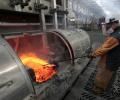
Novelis' Q3FY25 volume stood at 904,000 tonnes (down 1 per cent Y-o-Y, down 4 per cent Q-o-Q), due to lower VAP and automotive shipments. Revenue stood at $4.1 billion (+4 per cent Y-o-Y, down 5 per cent Q-o-Q).
 © 2026 Rediff.com - Advertise with us - Disclaimer - Privacy Policy - Sitemap - Feedback - About us - Terms of use - Grievances